The headline numbers say Hong Kong's office market has recovered. In the best buildings, that is true.
Premium office vacancy in Central has fallen to 8.5 percent, and prime rents on Hong Kong Island are up 20.7 percent so far this year, according to Real Estate Asia's reporting on Knight Frank's latest figures. Morgan Stanley's analysis, as reported by Retail News Asia, puts Central vacancy at 7.8 percent in August, down from 11.2 percent a year earlier, with Central rents up 7.3 percent. The report does not give the period for that rent figure.
Firms count differently, and rent growth in particular varies a lot from one to the next. It is worth checking which buildings each number covers. The direction is the same everywhere.
Cheung Kong Center II and The Henderson are close to full. Large occupiers are taking whole floors, including a US quantitative trading firm with three and a mainland securities house with two. Leasing around Lee Garden Eight in Causeway Bay has picked up as well.
Two markets, a few minutes apart
Look at the whole city and the picture changes. CBRE's third quarter report has overall vacancy at 15.5 percent, the lowest since early 2023. Rents in the core submarkets are rising, while rents in the decentralised ones continue to fall.
Central sits below 10 percent on the measures above. The city as a whole sits at 15.5 percent. Even allowing for different firms counting differently, that is a wide gap.
JLL's October monthly shows the largest rise in office vacancy in Wan Chai and Causeway Bay, up 0.6 percentage points, ahead of Hong Kong East and Kowloon East. Traditional office space is loosening there. When that happens, flexible space often fills the gap, for tenants who want less commitment and for landlords who want occupied floors.
Savills Hong Kong has pointed out that owners of older buildings are under real pressure. New premium space is still arriving in 2026 and 2027. It is smaller than the wave of 2024 and 2025, but it is still taking much of the demand. Some landlords have started converting whole floors into coworking space, or even student housing, to keep them occupied.
An average rent tells you very little about the building you are actually in.
Hong Kong has shown this split before. Prime assets pull away from everything else, usually under a different headline each time. What changes is which towers are winning and which are being converted.
Where the pressure lands
A large institution can treat this as a simple question about where to put a trading desk. It pays for the prime address and absorbs the cost.
A smaller business has a harder choice. An older building can mean renovation works, or a landlord whose priorities have shifted. A prime tower often means paying for more space, and more prestige, than the business needs.
Neither suits a sixty person company that is trying to reach one hundred and twenty.
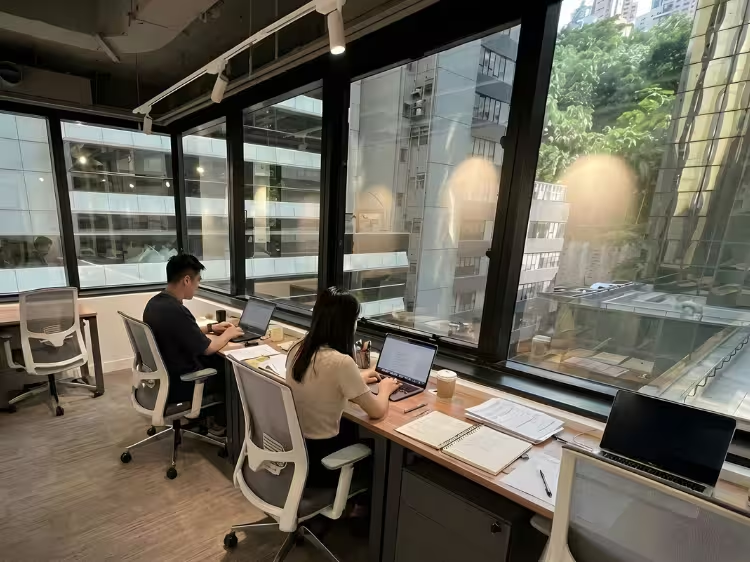
That middle ground is where flexible space tends to do well. A team can start with a desk, move to a private office and add rooms as it grows, without signing for floors it does not yet need.
Two questions worth asking
Rents will keep moving, and nobody times them well. Two questions matter more.
The first is how much of the commitment you can walk away from. A growing team rarely knows its headcount in three years, and a long lease prices that guess in.
The second is who runs the space. Some flexible space is a landlord filling empty floors. Some is built by an operator whose business depends on members staying and growing. The difference often shows in the service, and in how easily a team can move up a floor when it outgrows its room.
Where we sit
We have been running workspaces on Hong Kong Island since 2014, through more than one version of this cycle. The pattern holds now much as it did then. Businesses rarely want the cheapest desk or the most impressive address. They want space that can grow with them, without a three year commitment attached.
That is part of why we have just opened a fifth floor at our Central location on Duddell Street, alongside Causeway Bay, Wan Chai and Sheung Wan. Each location is built for teams that sit between the two speeds.
We do not have a view on where prime rents go next quarter. What a decade of renewals has taught us is that businesses squeezed from both directions are exactly who flexible space is for.
If you are weighing where your team should sit next, we are happy to talk it through. Get in touch through our contact page and we can unpack what this market means for your team.
Sources
Real Estate Asia, Hong Kong Island prime office rents rise 20.7% in YTD August, 2 October 2026.
CBRE, Hong Kong Figures, Office Q3 2026.
JLL, Hong Kong Monthly, October 2026.
SCMP, Hong Kong's small office landlords turn co-working, student hostels to survive, 1 March 2026.